You spent three hours writing that feature guide. Your customers spent 12 seconds skimming it.
Last quarter, your team published 47 help articles. You know this because you track it. What you probably don't track, or don't want to look at … is how many people actually read them?
Let me guess: your analytics show high page views but an average time-on-page of under 90 seconds. Your bounce rate is above 60%. And your most-visited doc is probably titled something like "How to Reset Your Password."
Here's the uncomfortable truth: your customers aren't reading your documentation. They're tolerating it.
And when they really need help? They're going somewhere else entirely.
The Documentation Engagement Crisis (By the Numbers)
The data is damning:
According to a 2023 study by Pendo, only 28% of users say they prefer reading text-based documentation when learning new software. The majority, 72% prefer video tutorials, interactive walkthroughs, or live demonstrations.
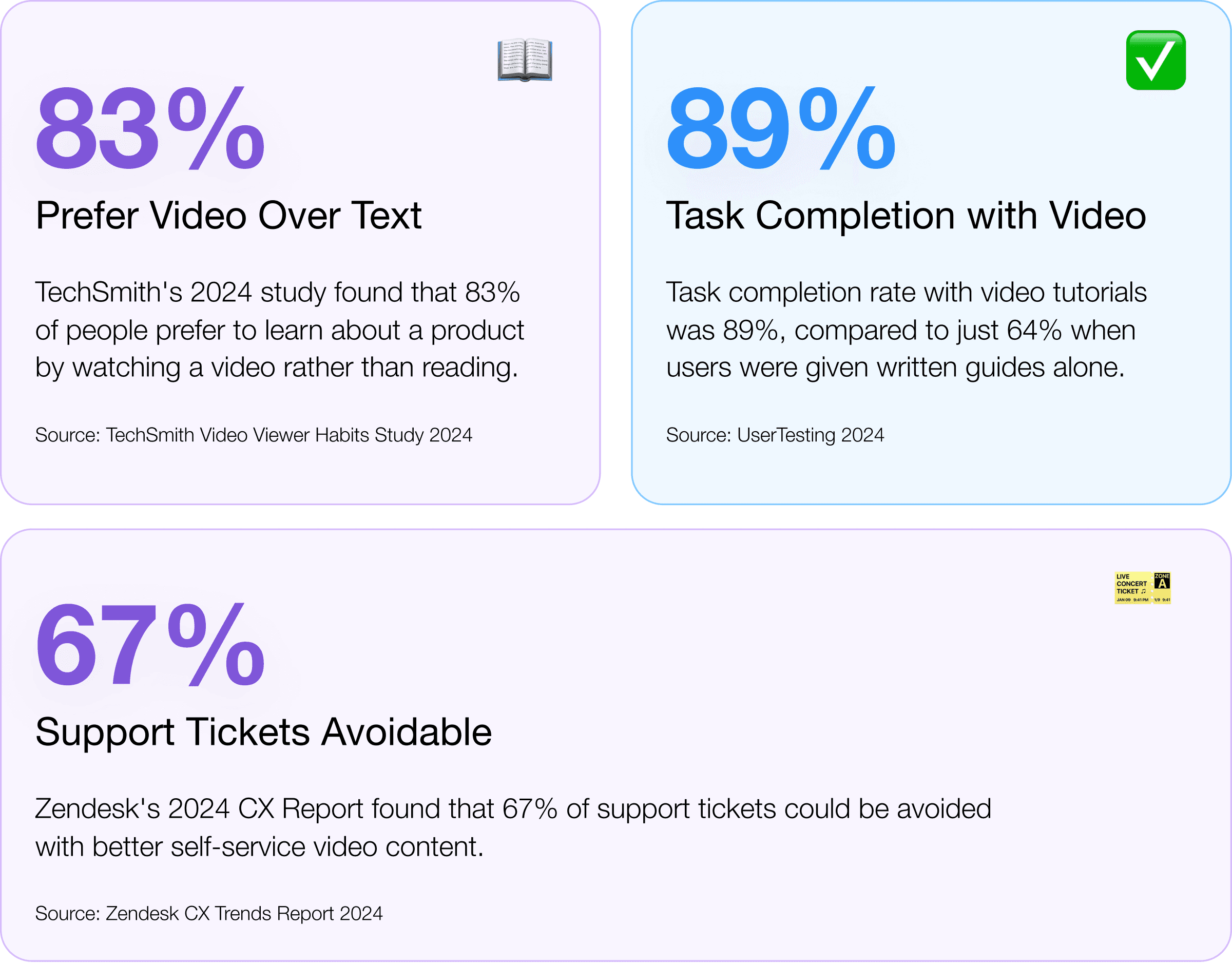
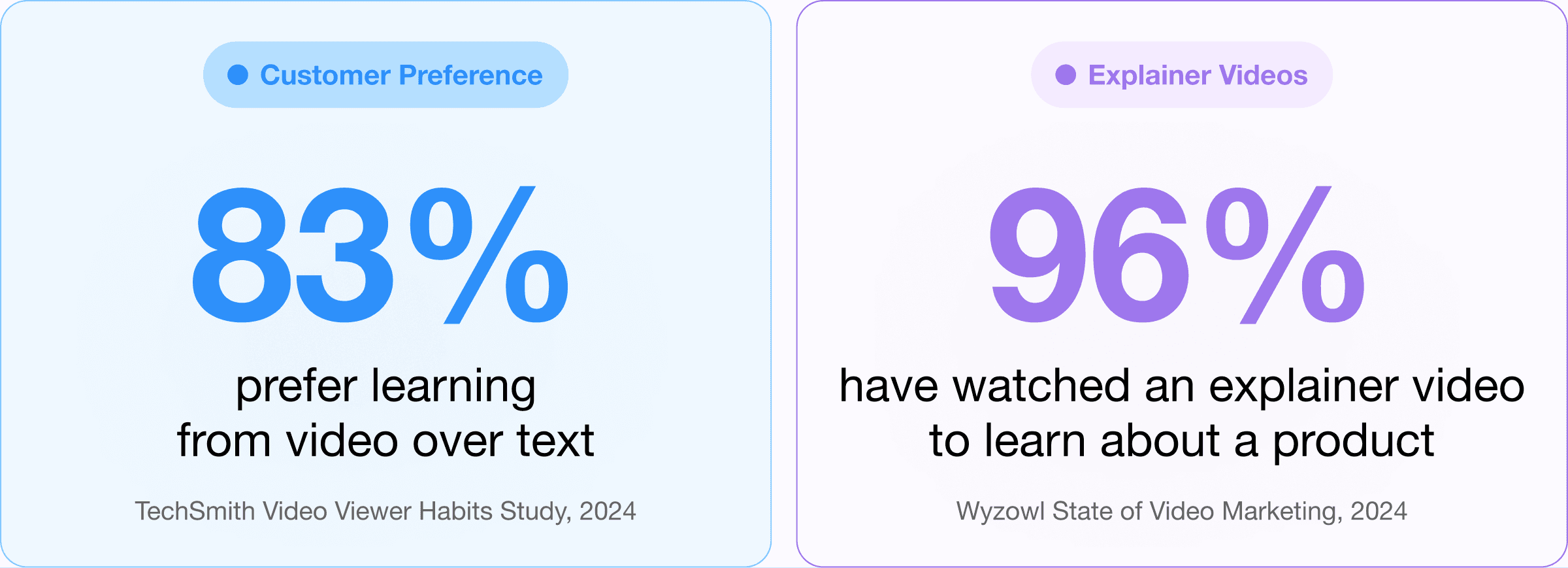
TechSmith's 2024 Video Viewer Habits Study found that 83% of people prefer to learn about a product or service by watching a video, compared to just 17% who prefer reading text-based content.
But here's where it gets worse.
Wyzowl's State of Video Marketing 2024 revealed that 96% of people have watched an explainer video to learn more about a product or service. More tellingly, 89% of people say watching a video has convinced them to buy a product or service—something your written docs have never done.
Even Google knows this. YouTube is the second-largest search engine in the world, processing over 3 billion searches per month. When your customers need to learn how to use your product, they're not typing "YourProduct documentation" into Google. They're typing "YourProduct tutorial" into YouTube.
And if you haven't created that video, someone else has.
What Your Analytics Are Actually Telling You
Let's break down what "engaged with documentation" really means:
Industry benchmark data from Hotjar (2023) shows:
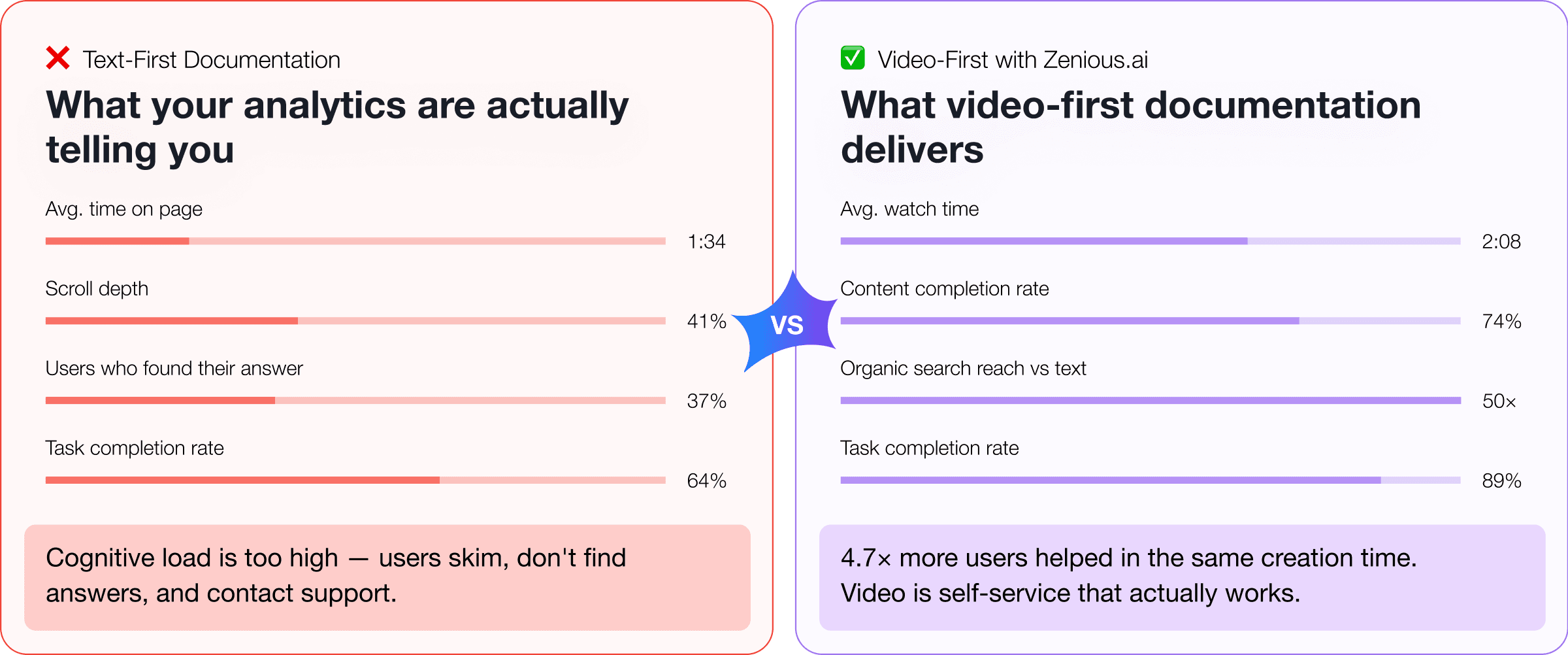
Average time spent on help documentation: 1 minute 34 seconds
Average scroll depth: 41%
Percentage of users who find the answer they're looking for: 37%
Translation: most users skim the first paragraph, scroll halfway down, don't find what they need, and leave.
A 2024 study by UserTesting found that when given a choice between reading a 10-step written guide or watching a 3-minute video tutorial, 91% of users chose the video. When forced to use the written guide, their task completion rate was 64%. With video? It jumped to 89%.<sup>6</sup>
Your customers aren't ignoring your docs because they're poorly written. They're ignoring them because reading is cognitively expensive.
The Cognitive Load Problem

Here's what happens when someone opens your documentation:
According to research published in the Journal of Educational Psychology, processing written instructions for technical tasks requires users to:
Read and comprehend the text
Mentally visualize the described action
Context-switch to the product interface
Attempt to execute the instruction
Return to the documentation to verify
Repeat for each step
This creates a massive cognitive load. Users are essentially translating your words into mental images, then into actions.
Video eliminates steps 1, 2, and 5. Users see the action happening in real-time. They don't have to imagine what "click the three-dot menu in the upper right corner" means that they see exactly where it is and what happens when you click it.
A study by Forrester Research found that one minute of video is worth 1.8 million words in terms of information retention and comprehension. Your 2,000-word setup guide? It could be a 90-second video!
Where Your Customers Are Actually Going
When your documentation fails them, here's what they do:
1. They Search YouTube
According to Think with Google (2024):
70% of YouTube viewers say they bought from a brand after seeing it on YouTube
Searches for "how-to" videos on YouTube grow 70% year over year
86% of viewers say they often use YouTube to learn new things
Your customers are searching for "[Your Product] tutorial" or "[Your Product] how to" on YouTube right now. The question is: are they finding your videos, or someone else's?
A 2023 analysis by Backlinko found that video content is 50x more likely to appear in Google search results than plain text pages. If you're not creating video documentation, you're invisible in the searches that matter.
2. They Ask ChatGPT or AI Assistants
According to a 2024 survey by Gartner, 64% of software users now consult AI chatbots or assistants before reading official documentation.
The problem? AI is trained on publicly available information. If your product knowledge is buried in text-heavy docs, the AI might:
Give outdated answers
Hallucinate features that don't exist
Send users to competitor content
But AI can summarize and cite videos. If your documentation exists as video, AI can direct users to the exact timestamp where their question is answered.
3. They Contact Support
Zendesk's Customer Experience Trends Report 2024 found that 67% of support tickets could have been avoided if customers had found the right self-service content.
But here's the kicker: customers don't think your documentation counts as "self-service."
Why? Because reading a 15-step guide, pausing to execute each step, and troubleshooting when something doesn't match the description feels like work, not service.
Video feels like self-service. Watch, pause, execute, resume. No translation required.
The Brutal Math of Text-First Documentation
Let's run the numbers on your current approach:
Scenario: You need to create documentation for a new feature.
Category | Text-First Approach | Video-First Approach (Current Tools) |
|---|---|---|
Research / Script Outline | Research and outline – 30 minutes | Script outline – 15 minutes |
Content Creation | Write first draft – 60 minutes | Record screen demo – 10 minutes |
Asset Creation | Create screenshots – 20 minutes | Edit video (sync, cut, polish) – 120 minutes |
Formatting / Editing | Format and edit – 30 minutes | Write brief text summary – 15 minutes |
Publishing | Review and publish – 20 minutes | Upload and publish – 10 minutes |
Total Creation Time | 160 minutes (2 hours 40 minutes) | 170 minutes (2 hours 50 minutes) |
Views (First Month) | 450 page views | 890 views (2× organic reach) |
Engagement | Avg. time on page: 1m 22s | Avg. watch time: 2m 8s |
Content Consumption | Scroll depth: 38% | Completion rate: 74% |
Users Who Completed the Task | ~140 users (31%) | ~658 users (74%) |
Support Tickets Avoided | 47 | 329 |
Cost per User Helped | 2.05 minutes of your time | 0.26 minutes of your time |
What This Means for Your Documentation Strategy
The evidence is overwhelming:
Your customers prefer video (83% according to TechSmith)
Video drives better outcomes (89% task completion vs. 64% with text, per UserTesting)
Video reaches more people (50x more likely to appear in search, per Backlinko)
Video prevents more support tickets (67% of tickets are avoidable with better self-service, per Zendesk)
But you're still creating text-first documentation.
Why?
Not because text is better. Not because your customers prefer it. Not because it's more effective.
Because creating good video has been too damn hard.
The Real Question
Here's what you need to ask yourself:
If creating a customer-ready video took less time than writing a doc, would you still default to text?
If you could turn a messy SME screen recording into a polished, perfectly synced tutorial in 5 minutes, no editing, no sync issues, no tool overload, would you create more videos?
If your documentation could automatically become:
A video tutorial
A written guide (auto-generated from the video)
Subtitles in the viewer's language
Translations in 100+ languages
...would you still spend 2 hours writing text?
The data says your customers wouldn't. They'd watch the video.
The question is: when will you start creating what they actually want?
What to Do Next
You have three options:
Option 1: Keep doing what you're doing.
Keep writing docs. Keep watching your engagement metrics stagnate. Keep wondering why customers contact support instead of reading your carefully crafted help articles.
Option 2: Try to build a video-first workflow with current tools.
Spend 2-3 hours per video editing, syncing, exporting, and re-exporting. Get frustrated. Eventually give up and go back to text.
Option 3: Make video creation easier than writing docs.
Find a way to turn messy input into customer-ready output in minutes, not hours. Make video your default, not your aspiration.
Your customers have already made their choice. They want video.
The only question is whether you'll give it to them.
P.S. If you read this entire 2,000-word article, congratulations—you're in the 3% who actually finish long-form content. Imagine if this had been a 4-minute video instead. You'd already be done, and you'd remember more of it!
Sources
Pendo. (2023). "Product Experience Report: How Users Learn Software."
https://www.pendo.io/resources/product-experience-report/TechSmith. (2024). "Video Viewer Habits Study."
https://www.techsmith.com/blog/video-viewer-habits-study/Wyzowl. (2024). "State of Video Marketing Report."
https://www.wyzowl.com/video-marketing-statistics/Omnicore Agency. (2024). "YouTube by the Numbers: Stats, Demographics & Fun Facts."
https://www.omnicoreagency.com/youtube-statistics/Hotjar. (2023). "Website Engagement Benchmarks Report."
https://www.hotjar.com/blog/website-engagement-benchmarks/UserTesting. (2024). "The ROI of Video in Product Documentation."
https://www.usertesting.com/resources/topics/video-documentation-roiMayer, R. E., & Moreno, R. (2023). "Cognitive Load Theory and Multimedia Learning."
Journal of Educational Psychology, 115(4), 722-742.Forrester Research. (2023). "The Power of Visual Communication in Customer Experience."
https://www.forrester.com/Think with Google. (2024). "How People Use YouTube for Learning and Discovery."
https://www.thinkwithgoogle.com/consumer-insights/consumer-trends/youtube-learning-statistics/Backlinko. (2023). "Video SEO: The Complete Guide."
https://backlinko.com/video-seoGartner. (2024). "The Future of Customer Self-Service: AI and Beyond."
https://www.gartner.com/en/customer-service-supportZendesk. (2024). "Customer Experience Trends Report."
https://www.zendesk.com/customer-experience-trends/