A story about onboarding friction, a good hire going quiet, and the moment the whole problem turned out to be something else entirely.

Nibu Thomas

You remember why you hired Meera.
She was the one who asked the sharp question in the final interview. The one whose reference call ran twenty minutes over because her old manager would not stop talking. You put the phone down and thought, we got lucky.
Week one, she is everywhere. Her notebook is always out and as usual, still asking good questions.
But week three, she has gone quiet.
Not dramatically. And nobody escalates ‘quiet’. She still shows up and says the right things in standup. But the questions have stopped, and that is the part that should worry you, because Meera is not someone who runs out of questions. She is someone who has learned it is easier not to ask.
You have seen this before, but never had a name for it.
The three weeks nobody tracks
Here is what happened in those three weeks, in the gaps between the meetings you did see.
Day two, Meera needed to run a workflow she had watched someone demo once. She half remembered it. She opened the internal wiki. She found a document. It was fourteen steps long, last updated for a version of the product that had a different menu, and the screenshot on step six showed a button that had since moved and is now missing.

She tried anyway and managed to get to step nine. However, something did not match. She sat there for a while.
Then she made the calculation every new hire makes.
If I ask, I interrupt someone. I look like I cannot handle a basic task in my third week. If I keep guessing, maybe I will figure it out, and nobody has to know I was stuck. So she guessed. It took her the better part of a morning. The task should have taken four minutes.
Multiply that by every workflow she has not yet learned. And that is her month.
"43% of users abandon a feature within the first week if they can't find clear guidance on how to use it. They don't assume the feature is broken. They assume they are." - Pendo, Product Experience Report
The cost of this is not the morning. The cost is what the morning teaches her. It teaches her that being stuck is something to hide. And a person who hides being stuck is a person who has quietly stopped learning out loud, which is the only way anyone learns fast in a new job.
You did not lose Meera. Not yet.
But you can feel her ramping slower than she should. And you cannot quite point to why.
Why does onboarding friction happen?
Onboarding friction happens when the knowledge a new hire needs exists somewhere in the company, but not in a form they can reach on their own, at the moment they need it, without asking another human. It is rarely a knowledge gap. It is almost always a handover gap.
Let that dwell, because it is the whole thing.
Everything Meera needed in those three weeks, someone at your company already knew.
The workflow that stumped her on day two? Your best onboarding specialist could run it in thier sleep. The setup that took Meera a morning? A colleague three desks away does it twice a week. The company was never missing the knowledge. Meera was just never handed it.
And the reason she was never handed it is not that people are unkind or too busy, although they are busy. The reason is more stubborn than that. For years, handing knowledge over properly was expensive.
The math that kept everyone repeating themselves
Think about what it used to take to turn what your best person knows into something Meera could use at 11pm on a Tuesday without troubling anyone.
Someone had to script it. Record it. Edit it on a timeline. Trim the dead air. Add captions. Export it. Upload it somewhere findable. And then redo half of that the next time the product changed.
That is hours of work to prevent a four-minute interruption. So of course nobody did it. Of course your best people just re-explained the same workflow for the twentieth time. Re-explaining took two minutes. Making the reusable version took two hours.
The math never favored the walkthrough. So the walkthrough never got made.
This is the part people get wrong when they talk about onboarding. They think the problem is documentation, or patience, or a better wiki, or a buddy system. Those are all attempts to work around the real constraint, which was simply that good walkthroughs cost too much to make.
Change that one number, and everything downstream of it changes.
The Tuesday that would have saved her
Now here is the part that should sting a little, in a useful way.
The walkthrough that would have saved Meera on day two already happened.
Last Tuesday, your best specialist walked a customer through that exact workflow on a screen share. Start to finish. Clearly, warmly, with all the little asides about what to do when the screen does not look quite right. It was the perfect onboarding walkthrough. It existed, in full, for about eleven minutes.
And then it evaporated, because nobody had a fast way to keep it.
That is the friction. It’s not a missing document, but a missing habit, made possible by a missing tool. Your company generates perfect walkthroughs constantly, in demos, in support calls, in the quick screen shares where one person shows another how something works. They happen and they vanish. Meera drowns three feet from water that gets poured out every single day.
"Task completion jumps from 64% with text-based documentation to 89% with video. That gap is not a preference. It is people succeeding, or not." - UserTesting
What changes when creation gets cheap
So here is the shift, and it is smaller and bigger than people expect.
When making a polished walkthrough stops taking two hours (or worse, two days) and starts taking two minutes, the math flips. Now it is cheaper to record the workflow once than to re-explain it once. And the moment that becomes true, people stop repeating themselves and start leaving a trail.

Your specialist records the customer walkthrough she was doing anyway. It becomes a clean video, a written guide, and, because your team is not all in one country, a version in whatever language the reader needs. From one screen recording. Without a timeline. Without a second tool.
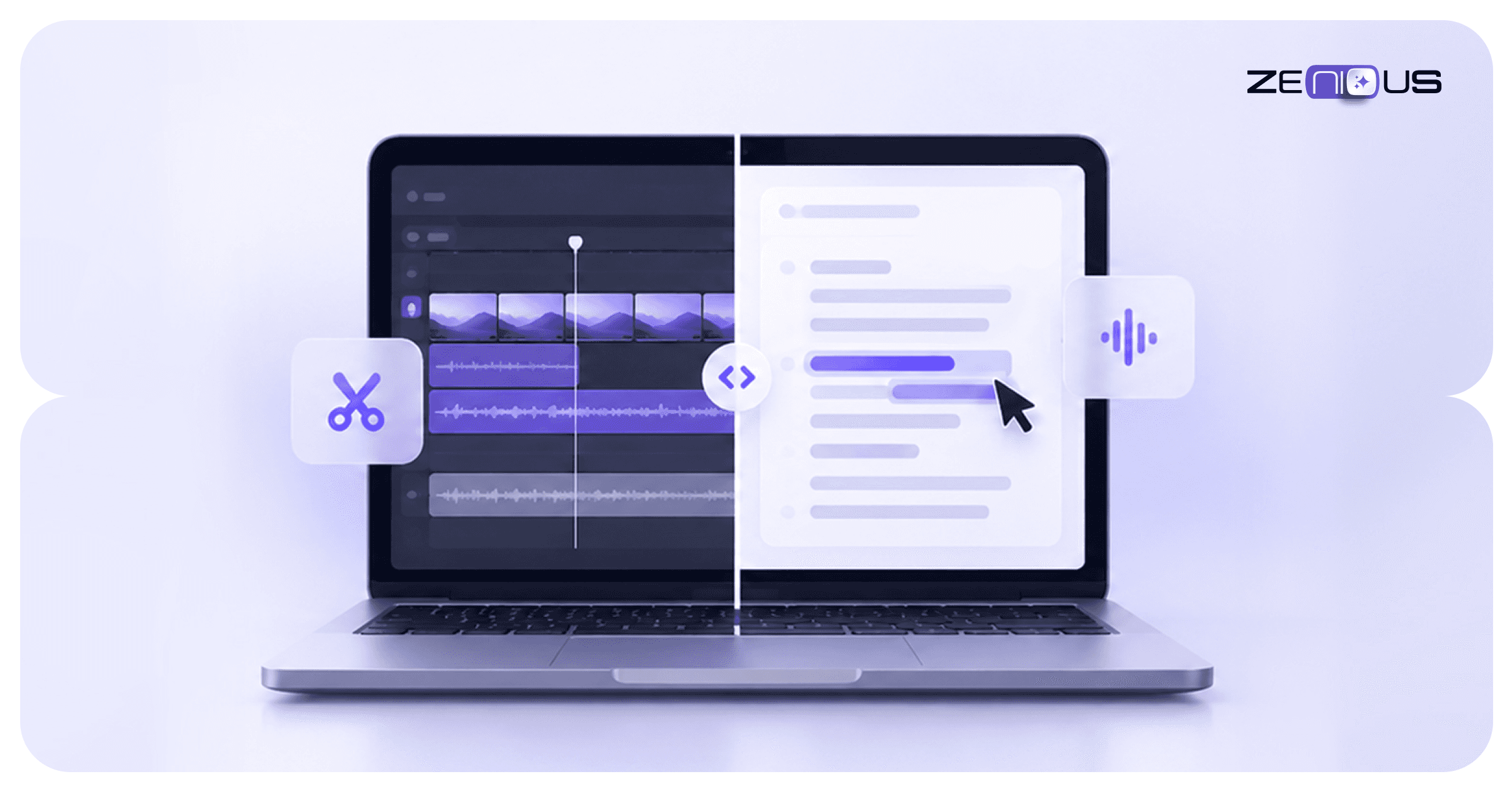
This is the part Zenious was built for. Not to make your team create more content, but to make the walkthroughs they already perform, every day, stop vanishing. A raw screen recording goes in. A professional walkthrough, a written guide, and translations in over a hundred languages come out. The knowledge that used to evaporate now stays.
If you want to feel the difference rather than read about it, try Zenious with one of your own walkthroughs. Record the next workflow you would otherwise explain out loud, and watch what comes back.
Picture Meera's day two in that company instead.
She half remembers the workflow. She searches. She finds a two-minute walkthrough, recorded last Tuesday, showing the real screen as it looks today. She watches it once. She does the task in four minutes. Nobody was interrupted. Nobody learned that being stuck is shameful.
She stays exactly who she was in week one. The one who asks the sharp questions.
The reframe
We have been told onboarding is about welcome kits and thirty-day plans and assigning a buddy. These are useful things, all of them. But they were always workarounds for a constraint nobody named.
Onboarding friction was never really about documents, or patience, or time.
It was about how expensive it was to hand knowledge from the person who has it to the person who needs it.
That price just dropped to almost nothing. When you make video creation so easy that it becomes the first choice of documentation for the people who have the knowledge.
Which means the next Meera you hire does not have to spend three weeks learning to hide. She can spend them learning out loud, the way you hoped she would when you put the phone down after that reference call and thought, we got lucky.
You did get lucky. Now make sure she never has to guess.
See what your own walkthroughs look like when they stop vanishing. Try Zenious.
Sources
Pendo. (2023). Product Experience Report: How Users Learn Software.
UserTesting. (2024). The ROI of Video in Product Documentation.
TechSmith. (2024). Video Viewer Habits Study. techsmith.com
Zenious. (2025). Zenious Product Documentation. zenious.ai