You can buy the best SOP software on the market and still lose. Because the tools all solve the easy problem, writing the procedure, and none of them solve the hard one, getting someone to actually follow it.

Nibu Thomas

You have written the SOP. It is a good one.
You spent the afternoon on it. You laid out the fourteen steps in order. You added the screenshots. You put it in the shared drive, in the right folder, and you sent the message: here is the standard way we do this now, please follow it. You formatted it nicely. You were, honestly, a little proud of it.
And then you watched people NOT use it.
The new hire asked a colleague instead of opening it. The experienced person kept doing it their own way, the way they have done it for three years. Someone got to step nine, found the screen did not match your screenshot, and quietly gave up on the document. Within a month, your carefully written SOP was a thing that existed but did not operate. It was true, and it was ignored.
Here is the sentence that should sting, because it is the whole problem in nine words.
"Most SOPs are designed to be written, not to be followed." - Soperate, How to Create SOPs That Actually Get Followed, 2026
That is the debate the SOP software market keeps avoiding. Every tool competes on how fast it helps you create procedures. Almost none of them compete on whether anyone follows the procedures you create. And those are completely different problems!
The market is optimizing the wrong number
Walk through the SOP software category and you will notice they all sell the same promise: create documentation faster. Capture a workflow, auto-generate the steps, share a link. It is genuinely useful, and Scribe and tools like it do it well. If your bottleneck is producing the document, a tool like Scribe for documentation removes that bottleneck cleanly.
But producing the document was never the expensive part. Getting it used was.
There is a quiet measurement error running through most organizations. They count SOPs created. Number of procedures documented, percentage of processes covered, size of the library. Those are creation metrics. They tell you how much you wrote. They tell you nothing about whether a single person changed their behavior because of it.
"The company measures success by the number of SOPs created rather than their adoption and effectiveness." - DV Consulting, Why Employees Don't Follow SOPs, 2026
This is why a company can have a magnificent, comprehensive, lovingly maintained SOP library and still run on tribal knowledge and hallway questions. The library is full. The adoption is empty. And the tool that helped fill the library did its job perfectly, because its job was creation, not adoption.
Why do employees ignore text SOPs?
Employees ignore text SOPs because reading a procedure and performing it are two different kinds of work, and the document leaves the harder one to the reader. A written SOP hands you a list of steps and asks you to translate each one into an action on your actual screen, in your actual tool, while you are trying to get the real task done. If the translation is even slightly off, a moved button, a renamed field, a screenshot from two versions ago, the reader stalls, and a reader who stalls once learns to stop opening the document.

The research on this is unusually blunt, so let me just lay it out.
A fifteen-page procedure for a task that takes ten minutes is simply a documentation theater. It looks impressive and nobody has time to read it while they are trying to work (Soperate, 2026).
The longer the SOP, the less likely anyone finishes it. People will not read a twenty-page document to complete a routine task (Tallyfy, 2026).
And the failure hides, because from the company's point of view nothing is broken. The SOP is technically correct. It is only wrong in the one way that matters, which is that it is not being followed.
None of this means text is bad. It means text is being asked to do a job it is poor at: teaching someone to perform a process they have never done, by describing actions instead of showing them. For that specific job, the format is the problem, not the writer.
What video-first actually changes
Now watch the same moment with a video-first SOP instead of a text one.
The new hire hits the step that used to stall them. Instead of a screenshot that no longer matches, there is a ninety-second recording of the real screen, as it looks today, with someone doing the exact thing and saying why.

They watch it once. They do it. They do not have to translate anything, because they are not reading a description of the action, they are watching the action. There is no gap between the instruction and the screen, because the instruction is the screen. The step that used to end their relationship with the SOP library instead builds it, because this time the document actually helped.
This is not a claim that video is prettier. It is a claim about completion and comprehension, and the numbers back it. People consistently prefer video for learning software, and video instruction is completed and retained at meaningfully higher rates than the text equivalent. A short walkthrough that gets watched to the end beats a perfect document that gets abandoned at step nine, every single time, because a procedure that is not followed has an effectiveness of zero no matter how well it is written.
The point of view here is not video-first for everything. It is video-first for the SOPs that have to teach, and text for the SOPs that only have to record.
So which format, for which SOP?
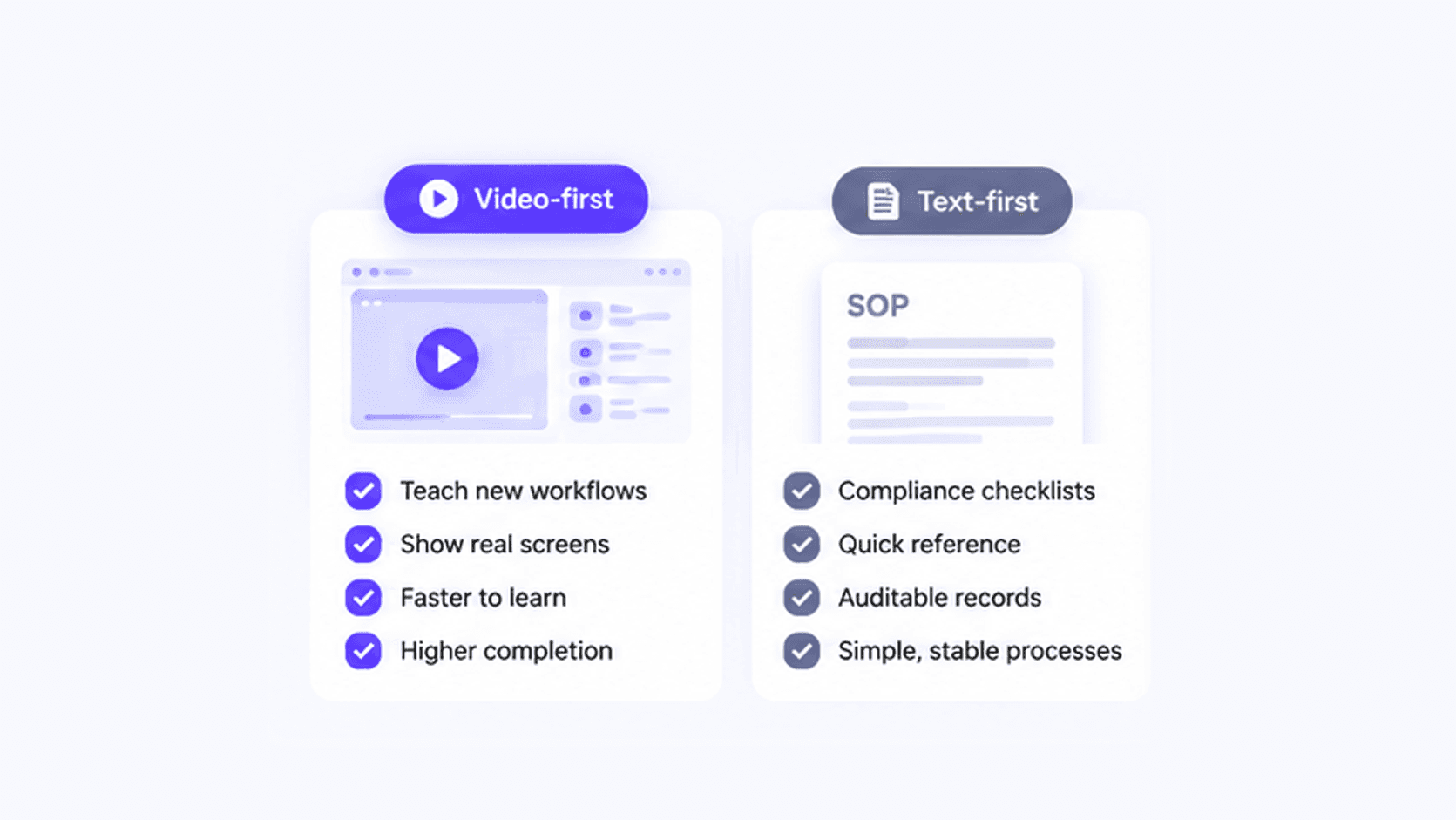
The honest answer is not that video wins and text loses. It is that they are good at different jobs, and the mistake most teams make is using text for all of them because text was the only thing that used to be cheap to produce. Here is the split that actually holds up.
The SOP is for... | Text-first wins when | Video-first wins when |
A compliance checklist someone signs off | The record has to be auditable, searchable, and version-controlled. A signature needs a document. | Rarely. This is text's home ground. |
A quick reference someone scans mid-task | The user knows the process and needs to confirm one step or a specific value. | The step involves a screen or a sequence that is faster to watch than to read. |
Teaching a process end to end | Almost never. Text asks the reader to imagine the actions. | The learner has to see pacing, context, and what the screen actually does. Video shows it. |
Onboarding someone to a tool | The tool is simple and stable, and a short guide is enough. | The workflow has judgment calls, edge cases, and moments where the screen may not match. Video carries all of it. |
A process that changes often | You can edit a line of text quickly, if anyone notices it went stale. | Re-recording the changed section is fast, and the learner sees the current screen, not last quarter's. |
Format guidance synthesized from Soperate (2026), Tallyfy (2026), Beyond The Chaos (2025), and DV Consulting (2026).
Read down the right column and you will notice it holds every SOP whose purpose is to teach a person to do something. That is most of them. The compliance checklist that needs a signature stays text. The walkthrough that needs to be learned wants to be video. A company that used text for both was not making a considered choice. It was living with the only format that used to be affordable to make.
The part that changed quietly
For years there was a good reason every SOP was text, even the ones that should have been video. Text was cheap to make and video was not. Writing a procedure took an afternoon. Producing a clean, narrated, edited walkthrough took days and a person who knew how to edit. So of course the whole library was text. The format was chosen by the cost of production, not by what the learner needed.
That cost is what changed. And when it changed, the debate changed with it.
This is where Zenious fits the SOP conversation. A screen recording of the process becomes a polished video SOP, a written version for the people who want to scan, and translations for teams who do not work in English, from one recording, without an editor. The text SOP and the video SOP stop being a choice between fast-to-make and nice-to-have, because both come out of the same few minutes of recording. If you want to see the difference on a procedure your team currently ignores, try Zenious on one of your own SOPs and watch whether it gets opened this time.
The question was never really video versus text. Both have a job. The question the old tools could not answer was whether the SOP you made would ever get used, and for the SOPs meant to teach, the format that gets used is the one people will actually watch.
Conclusion
We have been grading SOP software on the wrong test. We ask how fast it helps us write. We should be asking how likely it is that anyone follows what we wrote.
A perfectly written SOP that nobody reads is not documentation. It is a record of good intentions.
The best SOP is not the one that is most complete, or most compliant, or fastest to produce.
It is the one that gets watched, understood, and done, by the person standing in front of the task at the moment they need it.
Buy the tool that makes procedures easy to write, by all means. But do not confuse a full library with a followed one. The debate that matters is not which SOP software documents fastest. It is which SOP your people will actually use, and for anything you need them to learn rather than merely sign, that answer now looks a lot more like a video than a page.
Sources
Soperate. (2026). How to Create SOPs That Actually Get Followed. medium.com/@soperate
DV Consulting. (2026). Why Having SOPs on Paper Does Not Mean Employees Follow Them. dvconsulting.co.in/blogs
Tallyfy. (2026). Standard Operating Procedures: Why Most Fail and How to Fix Yours. tallyfy.com/standard-operating-procedure-sop
Beyond The Chaos. (2025). Why Teams Struggle to Follow SOPs and How to Fix It. beyondthechaos.biz/follow-sop
Consultevo. (2026). Why SOPs Nobody Follows Are a Systems Problem, Not a People Problem. consultevo.com
Trackmedium. (2025). The Psychology of Compliance: Why People Ignore SOPs. trackmedium.com/blog
Zenious. (2025). Zenious Product Documentation. zenious.ai