

Learn how global teams translate training videos into 100+ languages faster, reducing localization costs while scaling onboarding and product education.

Nibu Thomas
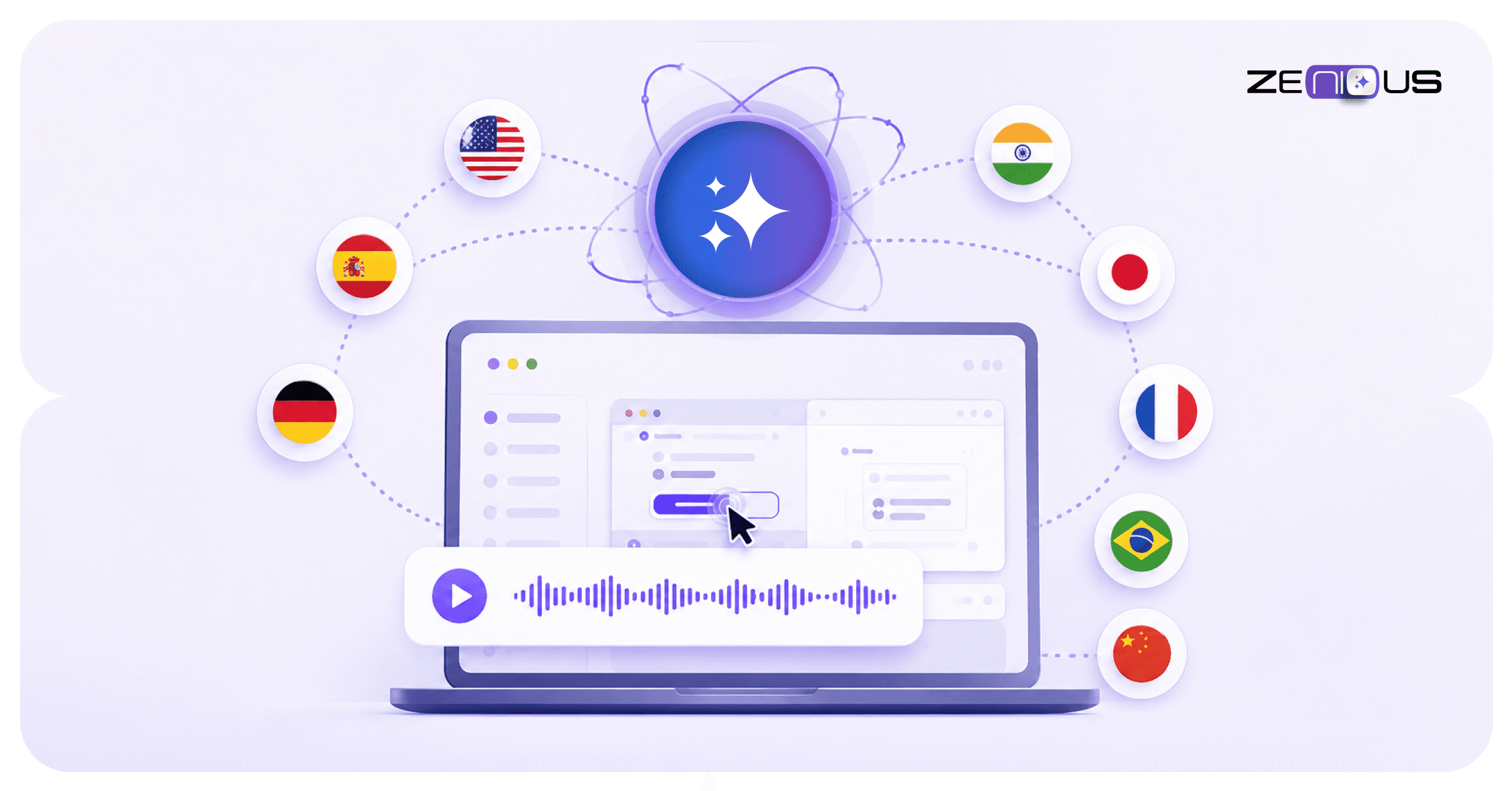
Picture a product team that has just shipped a major feature update. The release goes live simultaneously for users in Germany, Brazil, Japan, and the UAE. The engineering is solid. The product works.
But the onboarding video, a three-minute walkthrough that explains how the new workflow operates exists only in English. The support team in São Paulo is fielding questions it should not need to answer. The rollout in Tokyo is running two weeks behind because the training content isn't ready. And the VP of Customer Success is looking at activation data across regions and wondering why the numbers don't match.
The content gap is not a resourcing problem. It is a localization workflow problem. And it is playing out, with minor variations, at thousands of global organisations right now.
"Nearly 70% of enterprises require multilingual learning solutions to support global teams, yet 63% report that localization backlogs are a persistent bottleneck in their training delivery." Global Growth Insights, eLearning Localization Service Market Report, 2025
The reason the backlog persists is not a lack of intention. It is the cost and complexity of the traditional workflow for translating training videos a process that was designed for broadcast media, not for the pace of product documentation.
What It Actually Costs to Localize a Training Video the Traditional Way
Most organisations that have tried to translate training videos professionally have encountered the same surprise: it is far more expensive, and far slower, than the original video production. The reason is that traditional localization is not a single service. It is a chain of sequential steps, each requiring a different specialist, each adding time and cost.
Localisation step | Who does it | Cost estimate | Time required |
|---|---|---|---|
Script transcription | Transcription service or in-house | $1–3 / minute of video | 1–3 days |
Professional translation | Human translator per language | $0.12–0.30 / word | 3–7 days per language |
Subtitle formatting & sync | Localization agency | $8–20 / minute per language | 2–4 days per language |
Voice-over / dubbing (optional) | Voice talent + studio | $160–430 / minute per language | 1–2 weeks per language |
QA & review | In-house reviewer or LSP | 1–2 hrs at $50–150 / hr | 1–3 days per language |
Total (subtitles, 5 languages, 5-min video) | — | $600 – $2,500+ | 3–5 weeks |
Total (dubbing, 5 languages, 5-min video) | — | $4,000 – $10,750+ | 6–10 weeks |
Sources: VerboLabs (2025), GoLocalise (2025), ATL Translate (2024), Immersive Fox (2025), 3Play Media (2025)
The numbers above are for subtitling, which is the cheaper option. For full dubbing with professional voice talent, costs of $160 to $430 per finished minute per language are standard (Immersive Fox, 2025). A five-minute training video localized into five languages with professional dubbing can cost between $4,000 and $10,750 for the translation alone even before accounting for the original production cost.
For most teams, this arithmetic makes broad-scale localization impossible. The budget exists for one or two languages, for the highest-priority content only. Everything else either stays English-only or gets delayed indefinitely. The documentation gap between English-speaking headquarters and global teams becomes a structural feature of the organisation not a temporary problem, but a permanent condition.
"Reliance on bilingual employees as informal translators costs enterprises an estimated $7,500 annually per bilingual worker in lost productivity - an invisible tax that compounds across every team that lacks localized training content." - TechClass.com, 2026
Why Translate Training Videos at All? The Business Case
Before addressing the how, it is worth being precise about the why — because the business case for localized training content is considerably stronger than many VP-level decisions reflect.
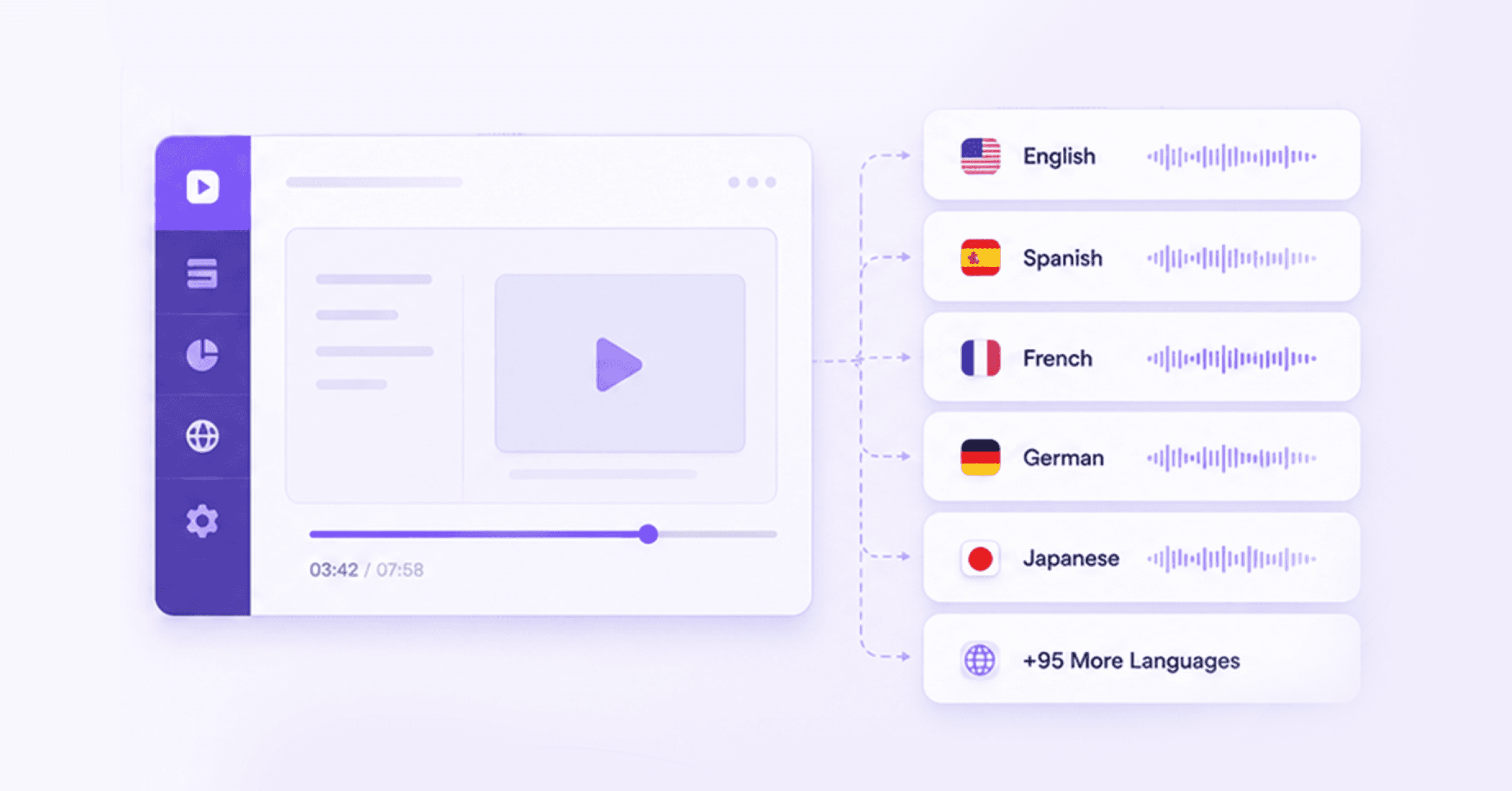
72% of learners show a strong preference for training content in their native language (Global Growth Insights, 2025). Preference is not just comfort, it directly affects comprehension, retention, and the likelihood of completing the training.
63% of organisations report measurable productivity improvements from localised training (Global Growth Insights, 2025). The ROI is not theoretical; it is visible in time-to-competency, error rates, and onboarding completion metrics.
85% of multilingual companies report higher employee productivity from localization initiatives (Zipdo, 2026). The effect extends beyond training, it shapes how confidently employees engage with tools, processes, and customers.
65% of localization projects exceed their budget due to scope creep (Zipdo, 2026) — a direct consequence of managing localisation as a project rather than a built-in workflow.
The data makes a consistent argument: teams trained in their native language perform better, onboard faster, and make fewer errors. The gap between knowing this and acting on it exists almost entirely because of the cost and complexity of traditional localisation workflows.
Changing the economics of the workflow changes the decision calculus entirely.
The Workflow Problem: Why Traditional Localisation Is Structurally Slow
The traditional approach to translating training videos was designed around broadcast media production timelines. A film, a commercial, a corporate brand video — content produced once, localized once, distributed for years. At that pace and volume, a six-week localization cycle is acceptable.
Product documentation, onboarding guides, and process training operate on a completely different rhythm. Features ship quarterly. Processes change monthly. A training video created in March may be partially inaccurate by June. At that pace, a workflow that takes six to twelve weeks to localize a single video is not just inconvenient — it is incompatible with how modern product and operations teams actually work.
The result is a predictable pattern: organisations localize their hero content — the onboarding video, the flagship feature walkthrough, the compliance course — and leave everything else untranslated. The long tail of documentation that makes up the majority of a user's actual experience with a product or process stays English-only indefinitely.
"50% of localization projects face content currency issues within 6 months — meaning localized content becomes outdated faster than it can be refreshed through traditional workflows." — Zipdo Localization Industry Statistics, 2026
This is the structural problem that a different model solves — not by making the traditional workflow faster, but by removing it almost entirely from the documentation process.
A Different Model: Translation as Part of the Workflow, Not After It
The traditional localization workflow is a post-production process. You create the content first, then translate it. Each translation is a separate project, with its own brief, timeline, and budget. The more languages you support, the more that multiplier grows.
A workflow built around automated translation inverts this model. Translation is not a separate step. It is a feature of the creation tool. When a product manager records a five-minute feature walkthrough, the output is not an English video with a localization backlog attached. It is a video available in 30 or 100 languages simultaneously — captions auto-generated, subtitles auto-synced, ready for global distribution from the moment of creation.
What This Looks Like Step by Step
Step | Traditional localisation workflow | Zenious workflow |
|---|---|---|
1. Create base video | Record + edit with agency or in-house editor: 1–3 weeks | Record screen or demo. Zenious auto-produces polished output: same day |
2. Transcription | Send to transcription service: 1–3 days | Auto-generated transcript included with video output |
3. Translation | Brief translators per language, await delivery: 3–7 days each | 100+ language translation generated automatically |
4. Subtitle sync | Manual or agency QA per language: 2–4 days each | Subtitles auto-synced to translated transcript |
5. QA & publish | Review round per language: 1–3 days each | Review once, publish across all languages simultaneously |
Total time (5 languages) | 6–12 weeks | 1–2 days |
Total cost (5 languages) | $600 – $10,750+ depending on format | Included in Zenious processing cost (under $5/min base) |
Workflow comparison based on standard agency localization timelines (3Play Media, GoLocalise, VerboLabs, 2025) versus Zenious automated processing.
The six-to-twelve week localization cycle collapses to one to two days — not because quality is being sacrificed, but because the sequential human handoffs that created the timeline are replaced by automated processing that runs in parallel.
What Changes Downstream
When translation is built into the documentation workflow rather than bolted on after it, several things change structurally:
New feature releases ship with multilingual documentation on day one — not six weeks later when the localization backlog clears.
Updating content no longer multiplies by the number of languages. A re-record updates all language versions simultaneously.
The documentation gap between HQ and global teams closes — not through a budget increase, but through a workflow change.
Bilingual employees stop functioning as unofficial translators — reclaiming the estimated $7,500 annual productivity cost per worker currently lost to informal language support.
The strategic implication is significant. Organisations currently making tradeoffs between supported languages, prioritizing Spanish and French while leaving Japanese, Arabic, and Portuguese un-served, are making those tradeoffs because of workflow cost, not strategic intent. Remove the workflow cost, and the tradeoff disappears.
"The global eLearning localization market is projected to reach $4.1 billion by 2034, driven by the recognition that consistent multilingual training is a competitive advantage, not a compliance overhead." — Global Growth Insights, 2025
The Decision Framework for Global Documentation Leaders
If you are a VP or Director responsible for training consistency across global teams, the question this article is really asking is: what is the current cost of your documentation gap, and is it higher than the cost of closing it?
The documentation gap has a calculable cost: support tickets that localized training would deflect, onboarding delays in non-English markets, productivity losses from informal translation, and activation gaps between regions. Most organisations have not calculated this number precisely, but the components are visible in support volume by market, time-to-competency by region, and completion rates for English-only training in non-English-speaking teams.
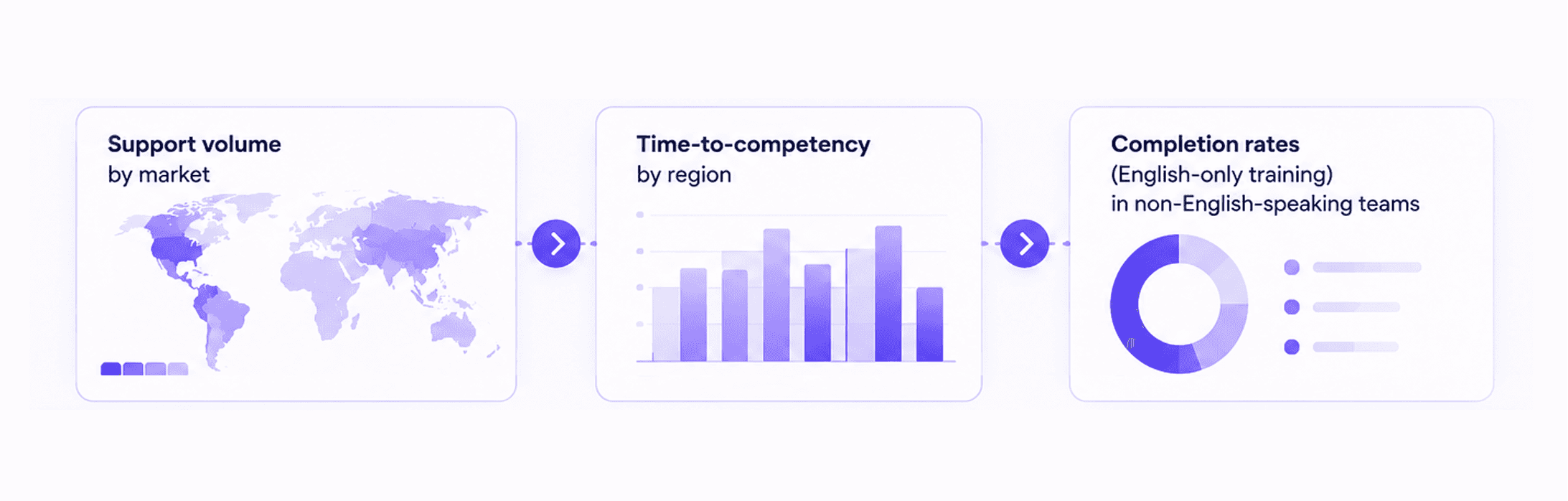
The workflow cost of closing that gap, traditionally measured in weeks and thousands of dollars per language, has been the primary reason that gap persists. When that cost drops to days and dollars per language, the decision calculus changes.
Zenious makes translation a default output of the documentation workflow, not a separate project. A screen recording goes in. Polished, multilingual video documentation comes out - in over 100 languages, with captions auto-generated and subtitles auto-synced. The localization backlog does not shrink. It disappears.
For teams that have accepted the English-only documentation gap as an operational reality, that is a meaningful shift. The gap was never necessary. It was always a workflow problem and these problems, unlike budget problems, are solvable.
Sources
Global Growth Insights. (2025). eLearning Localization Service Market Report. globalgrowthinsights.com
Immersive Fox. (2025). Multilingual Training Video: AI vs. Traditional Cost Comparison. immersive-fox.com
VerboLabs. (2025). Subtitling Rates 2025: Costs, Key Factors & Process Explained. verbolabs.com
GoLocalise. (2025). Video Translation Rates: A Complete Pricing Guide. golocalise.com
3Play Media. (2025). The Cost of Translation: Breaking Down Vendor vs. In-House Options for Video. 3playmedia.com
TechClass.com. (2026). Break Language Barriers in Corporate Training: An LMS Guide for Global Teams. techclass.com
Zipdo. (2026). Localization Industry Statistics. zipdo.co/localization-industry-statistics
Unbabel. (2023). Global Trends in Marketing Localization Report. unbabel.com


