

Compare video-first and text-first SOP software to improve employee training, onboarding, process documentation, and SOP adoption.

Nibu Thomas
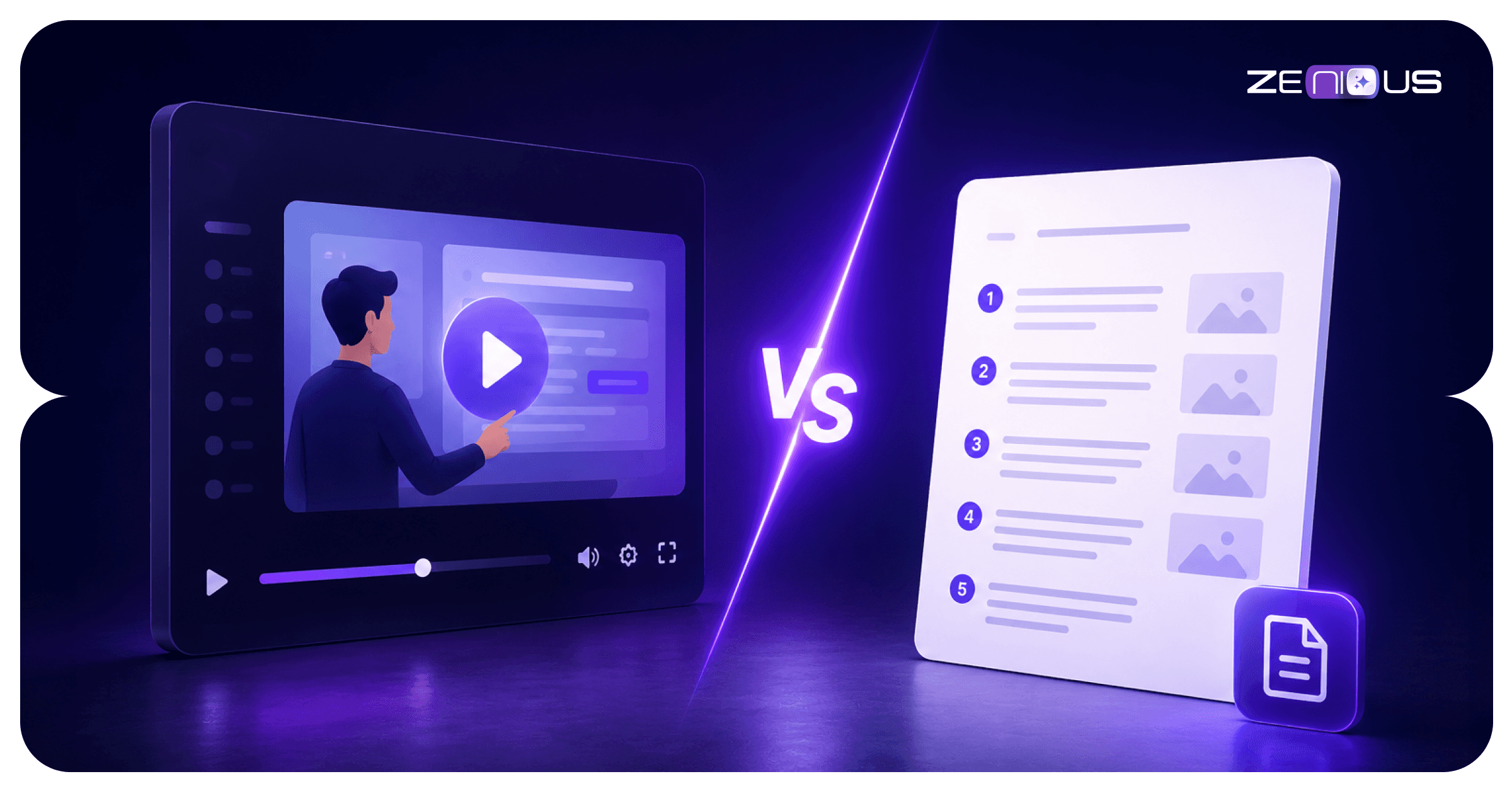
There is a specific frustration that operations leaders know well. You invest time and budget building out comprehensive SOPs. They get written, reviewed, uploaded, and shared. And then, quietly, nothing changes. Nothing! Your team keeps asking the same questions. New hires make the same mistakes. The documentation sits in a folder somewhere, technically available but functionally invisible!
The standard response is to improve the writing, reorganize the structure, or move to dedicated SOP software. Tools like Scribe have built entire businesses on making text-based process documentation faster to create. And they are right that creation speed is part of the problem.
But creation is not the whole problem. Adoption is. And when you look at the data on how employees actually engage with process documentation, it will hit you har. The medium matters just as much as the message.
The Text-First SOP: Fast to Create, Slow to Consume
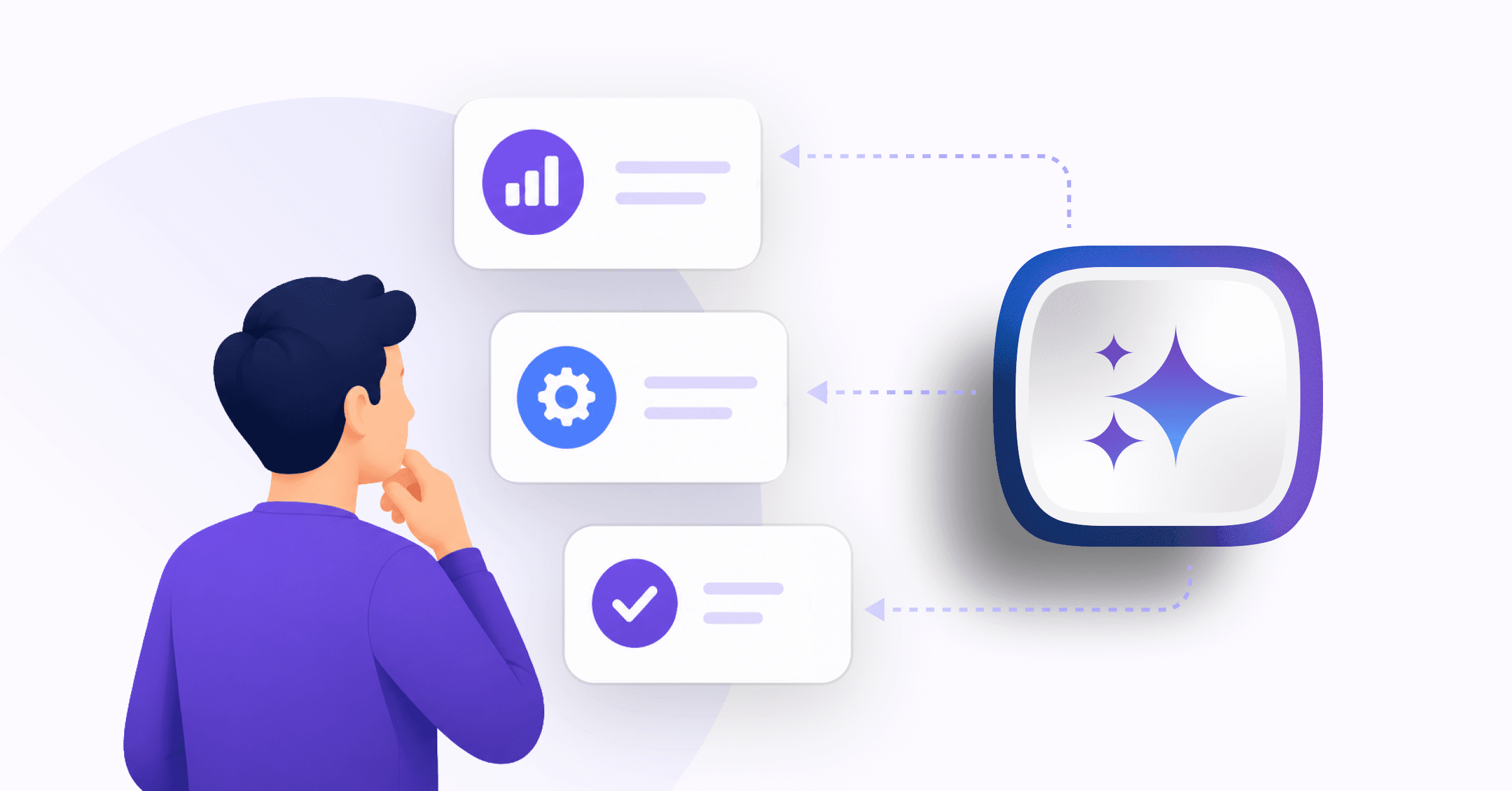
The dominant model in SOP software today is text-first. A tool like Scribe for example captures your screen as you work, automatically generating annotated screenshots and step-by-step text instructions. It is genuinely faster than writing SOPs manually. The output is visual, structured, and all this is shareable within minutes.
For the right use cases, this model works well. Compliance checklists. Policy references. Simple click-path guides for stable software. Anything where an employee needs to scan for a specific step rather than learn a process end-to-end.
The problem emerges when text-first documentation is used as the default for everything. And everything includes complex workflows, onboarding programs, product training, and cross-functional process guides. In those contexts, the format creates a quiet but measurable adoption gap.
"49% of workers admit to skipping or not fully engaging with mandated training content often treating it as a box to check rather than a resource to use." Shortlister / Continu Corporate eLearning Report, 2024
Long-form eLearning courses, the category most closely analogous to detailed text SOPs have average completion rates of around 20%. That means four out of every five employees assigned a text-heavy process document are not finishing it. They skim. And then they stop. They reference it once and forget where it lives.
This is not a motivation problem. It is a format problem. Text SOPs are written for auditors. It is structured for compliance and completeness. They are rarely designed for the cognitive reality of someone trying to learn a new process in the middle of a busy workday.
What Employees Actually Engage With
The research on employee learning preferences consistently tell us something:
83% of employees prefer video over text for learning software and processes (TechSmith, 2024)
Video-based training has a 75% higher completion rate compared to text-based training programmes (Kaltura, 2024)
Audio-visual learning boosts knowledge retention by 25–60% compared to text-only instruction (Research.com, 2024)
Microlearning video modules - the format most similar to a well-structured video SOP, see roughly 80% completion rates, versus 20% for long-form text content (Continu, 2024)
These numbers do not suggest that text SOPs are worthless. They suggest that for instructional content, the kind that requires a person to learn and apply a process, video is meaningfully more likely to get watched, completed, and retained than text is to get read.
"The SOP software market was valued at $1.2 billion in 2024 and is projected to reach $3.5 billion by 2033. And yet the central adoption challenge hasn't changed: most process documentation still goes unused." Verified Market Reports, 2024
Video-First SOPs: The Engagement Case
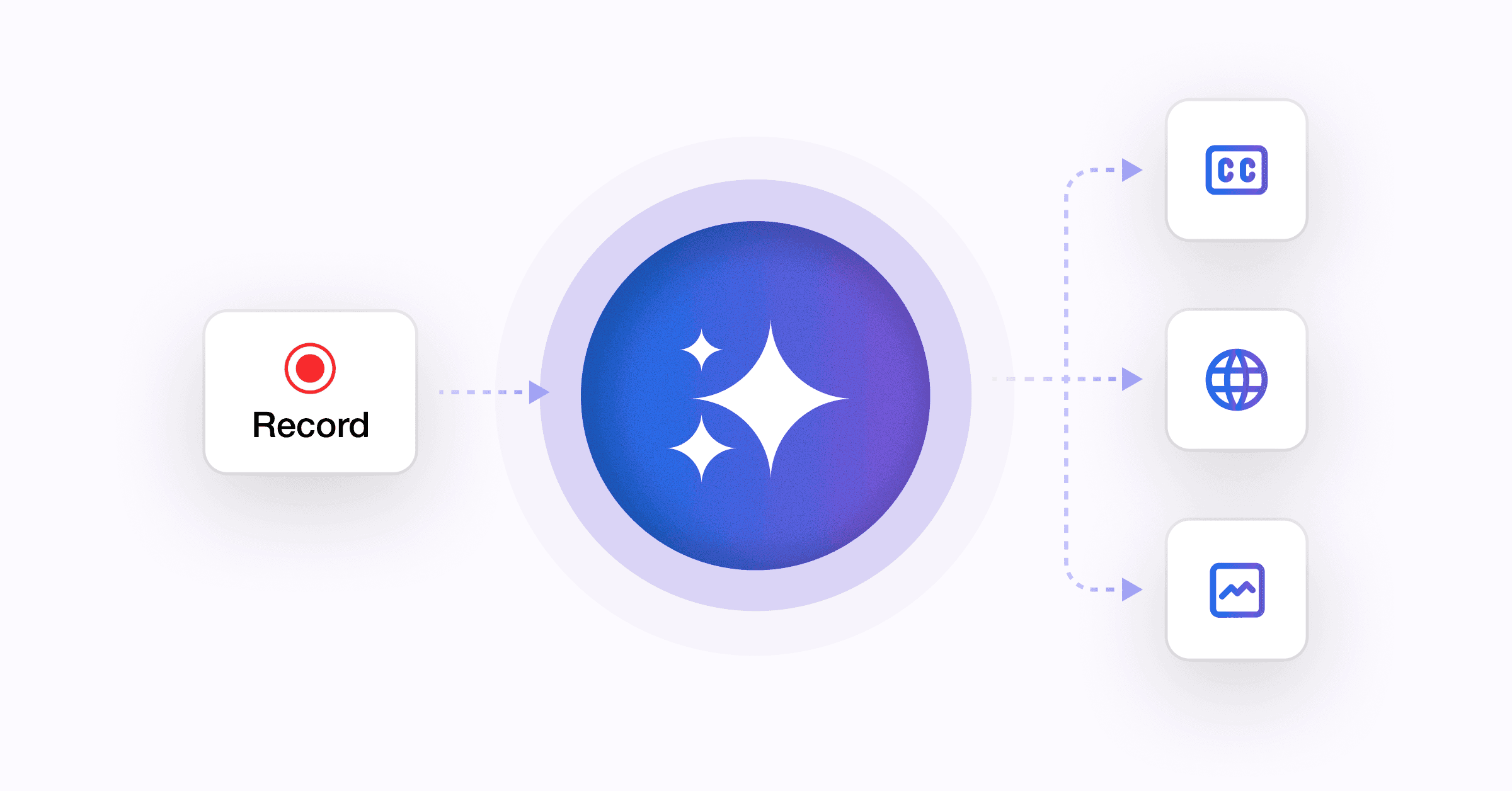
Video-first documentation takes the same input - a screen recording of someone performing a process - and produces a different output: a walkthrough that shows context, pacing, and nuance that annotated screenshots could never convey.
For certain categories of SOP, this matters enormously. Onboarding a new hire to a complex internal tool is not just about knowing which buttons to click. It is about understanding when to click them, in what context, and what to do when the expected screen does not appear. Text and screenshots can describe this. Video demonstrates it.
The historical objection to video SOPs was production burden: shooting, editing, syncing audio, adding captions, and exporting took far more time than writing an equivalent guide. That calculus is shifting. When video production is automated, a raw recording goes in, a polished output comes out, the creation time becomes comparable to or faster than building a high-quality Scribe guide. And the downstream engagement is substantially higher.
The Head-to-Head: Text-First vs Video-First
Dimension | Text-first SOP (e.g. Scribe, Notion, Word) | Video-first SOP (e.g. Zenious) |
|---|---|---|
Creation speed | Fast for simple click-capture; slower for narrative processes | Fast: record once, automated polish |
Employee completion rate | Low. Text-heavy content averages 20% long-form completion | High. Video averages 75% higher completion than text |
Knowledge retention | Moderate. Text requires active reading | High. Audio-visual learning boosts retention 25–60% |
Update effort after process change | Edit text and re-screenshot; manageable | Re-record affected section; comparable with modern tooling |
Works for global / multilingual teams | Requires separate translation effort | Captions and translations auto-generated |
Suits complex, multi-step workflows | Partial. Screenshots help but long guides lose readers | Strong. Video shows context, pace, and nuance text can’t convey |
Audit / compliance trail | Strong. Text is searchable and version-controlled | Improving transcripts make video content searchable |
Sources: Kaltura (2024), Research.com (2024), TechSmith (2024), Continu (2024)
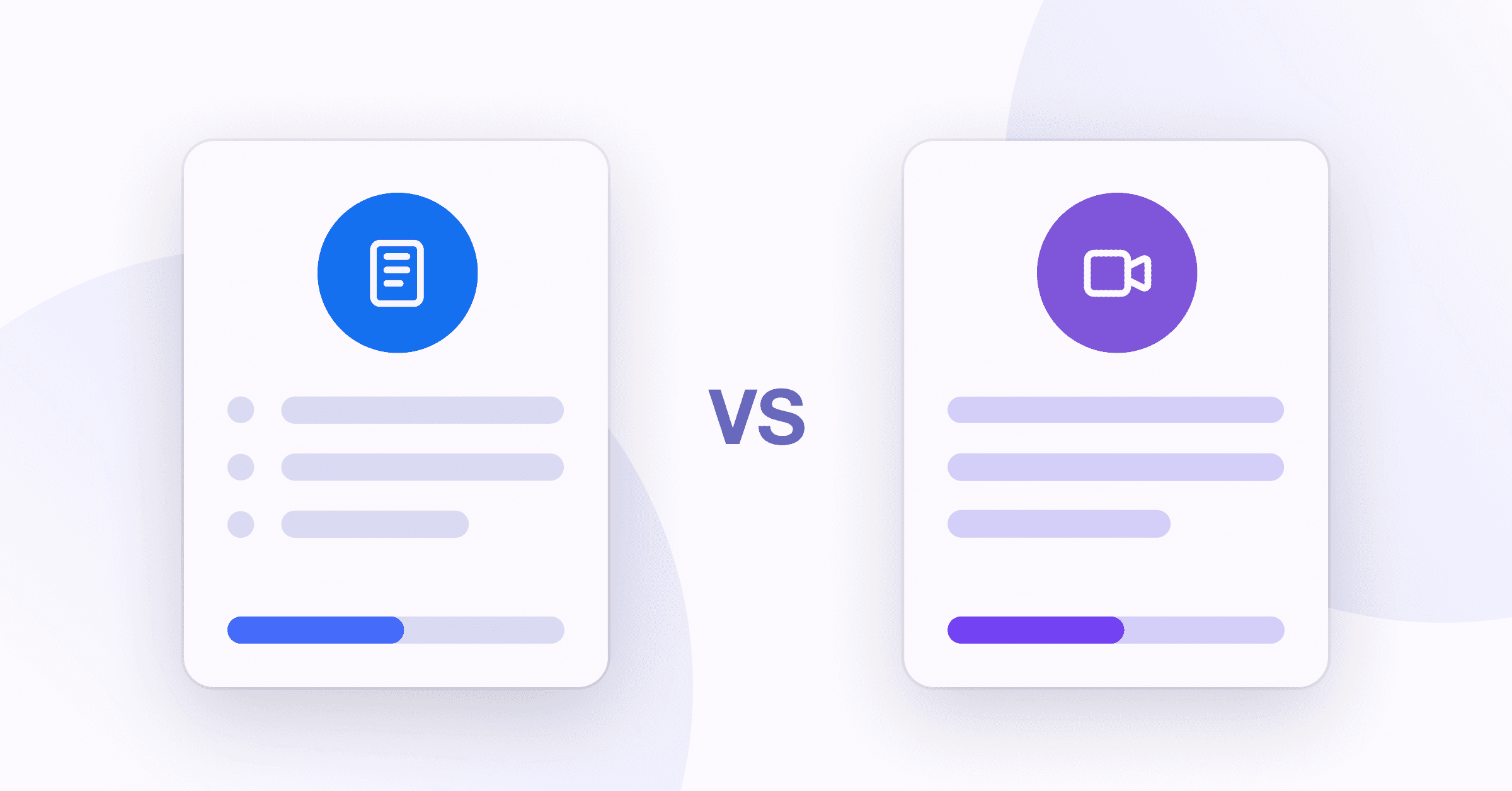
The comparison is not a clean win for either format. Text-first SOP software has genuine strengths, particularly for compliance, policy documentation, and content that employees need to search rather than learn. The critical mistake is treating it as the default for all SOP types, including instructional and training content where video's completion rate advantage is measurable and significant.
The Right Question Isn't Text vs Video
The SOP software debate is often framed as a binary choice. In practice, the most effective documentation strategies are not ideologically committed to either format. They match the format to the use case.
SOP use case | Best format | Why |
|---|---|---|
Onboarding new hires to software tools | Video-first | Shows context, click paths, and pace that text cannot replicate |
Compliance checklists requiring sign-off | Text-first | Auditable, searchable, easy to version-control |
Customer-facing product walkthroughs | Video-first | 83% of users prefer video for learning software (TechSmith, 2024) |
Internal policy documentation | Text-first | Policy docs are reference material, not instructional content |
Process training for distributed or multilingual teams | Video-first | Auto-captioning and translation make video scale globally |
Regulatory SOP with complex cross-references | Text-first | Legal precision requires text; hyperlinks outperform timestamps |
Recurring how-to guides for frequently changing tools | Video-first | Re-recording is now comparable in effort to updating screenshots |
The pattern is consistent: text-first documentation works well for reference material. Content employees look up rather than learn from. Video-first documentation works well for instructional content and processes where understanding sequence, context, and visual cues matters for successful execution.
Most organisations currently use text-first tools for both categories. This is partly historical (video production was expensive and slow), partly habitual (Scribe and similar tools are genuinely fast for creating text guides), and partly because the completion rate data was not widely visible when these decisions were made.
"Companies that standardize processes can reduce errors by up to 90% but only when the process documentation is actually followed. The format of that documentation is a primary determinant of whether it gets used at all." Beyond The Chaos, 2025
What This Means for Your SOP Software Decision
If you are evaluating SOP software for the first time, or reconsidering tools you already use, the completion rate data should be a central part of the conversation. The right question is not which tool makes SOPs fastest to create. It is which tool produces SOPs your team will actually finish.
For a VP or Director responsible for process consistency and training outcomes, the cost of an unread SOP is not zero. It is the cost of repeated errors, inconsistent execution, extended onboarding, and the support overhead of questions that documented processes should answer.
The practical framework is straightforward:
Audit your current SOPs by type. Separate reference content (policy, compliance, checklists) from instructional content (onboarding, tool training, process walkthroughs).
Apply format to category. Text-first tools like Scribe serve reference content well. Video-first tools serve instructional content better.
Measure completion, not creation. If your analytics show low engagement on process guides, the content is probably fine. The format is probably wrong.
This is the gap Zenious is designed to close. It takes the raw material your team is already producing - screen recordings, demos, walkthroughs - and turns them into polished video SOPs that employees actually watch and complete. Not a replacement for text-first SOP software where text serves the use case. A complement to it, for the instructional content where video's completion rate advantage is too large to ignore.
The SOP software debate is not really about tools. It is about whether the documentation you invest in actually changes behaviour. Format is the variable that has been underweighted for too long.
Sources
Kaltura. (2024). State of Video in Learning & Development Report.
Research.com. (2024). 28 Video Training Statistics: 2026 Data, Trends & Predictions. research.com/education/video-training-statistics
TechSmith. (2024). Video Viewer Habits Study. techsmith.com
Continu / Shortlister. (2024). Corporate eLearning Statistics. continu.com/research/corporate-elearning-statistics
Verified Market Reports. (2024). Standard Operating Procedures Software Market Size & Forecast. verifiedmarketreports.com
Beyond The Chaos. (2025). Why Teams Struggle to Follow SOPs and How to Fix It. beyondthechaos.biz
ProProfs KB. (2026). 10 Best SOP Software for Process Documentation & Scaling. proprofskb.com/blog/best-sop-software
Enboarder. (2024). Automated Onboarding Productivity Report.


