It's not lack of budget or the the lack of skill. It's friction and it's costing you more than you realise.

Nibu Thomas
At some point in the last year, someone on your team made the case for creating more video content. Tutorials, Product walkthroughs, Onboarding guides, whatever you call them. The kind of content your customers actually want.
And at some point, that initiative stalled. The reasons sounded reasonable. The team was stretched. The tools were complicated. Nobody had editing experience. There were more urgent things to ship.
So you stayed with text. And the gap between what your customers need and what your documentation delivers quietly widened.
Here is what nobody is telling you: the reasons your team gives for not creating video are not wrong. They are just not the root cause! They are symptoms of a single, solvable problem that most organisations mistake for a talent or budget gap.
The real reason is friction. And unlike talent or budget, friction can be engineered away.
The Excuses Are Real. The Diagnosis Is Wrong.
Before dismissing your team's objections, it's worth taking them seriously. Each one contains a genuine observation — just not the correct conclusion.
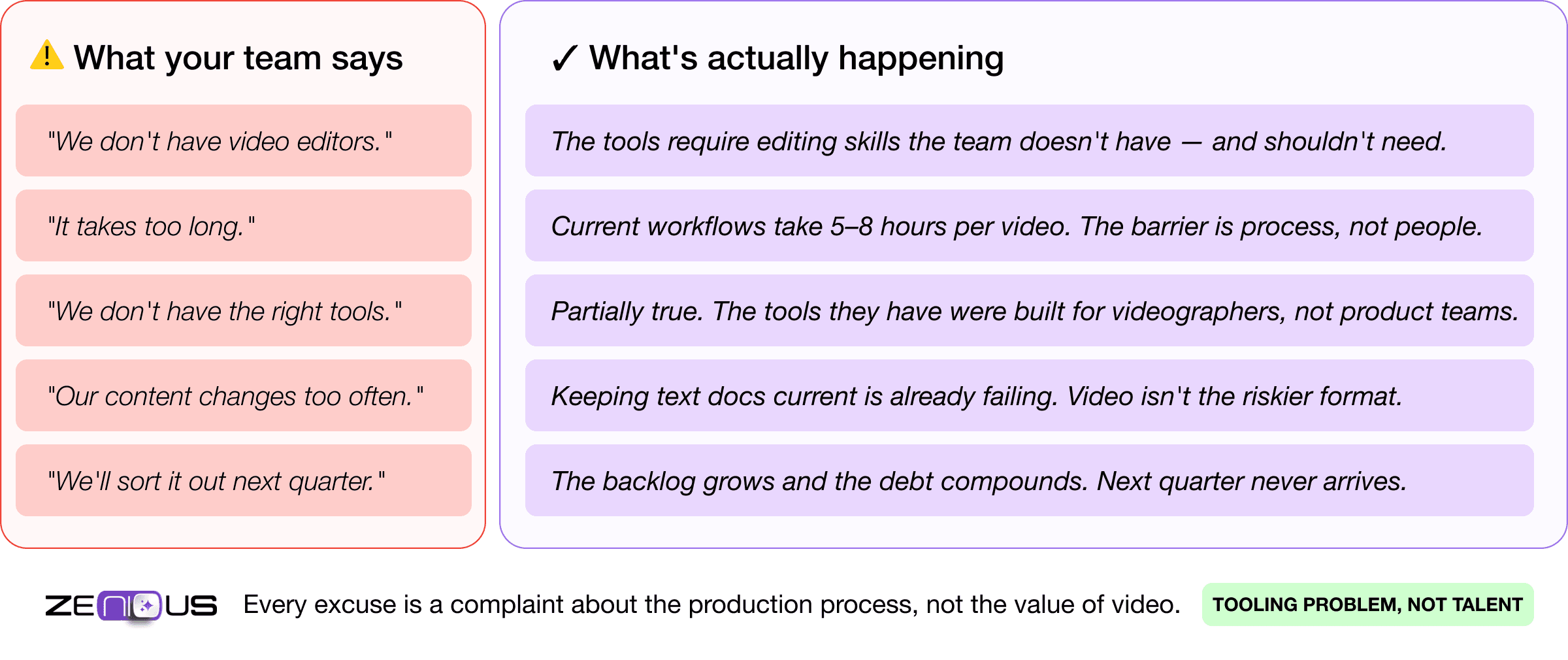
Notice the pattern. Every excuse is, at its core, a complaint about the production process, not about the value of video, not about team capability, and not about available time in the abstract. The team knows video is better. They've said so. They just can't make it work inside the tools and workflows they've been given.
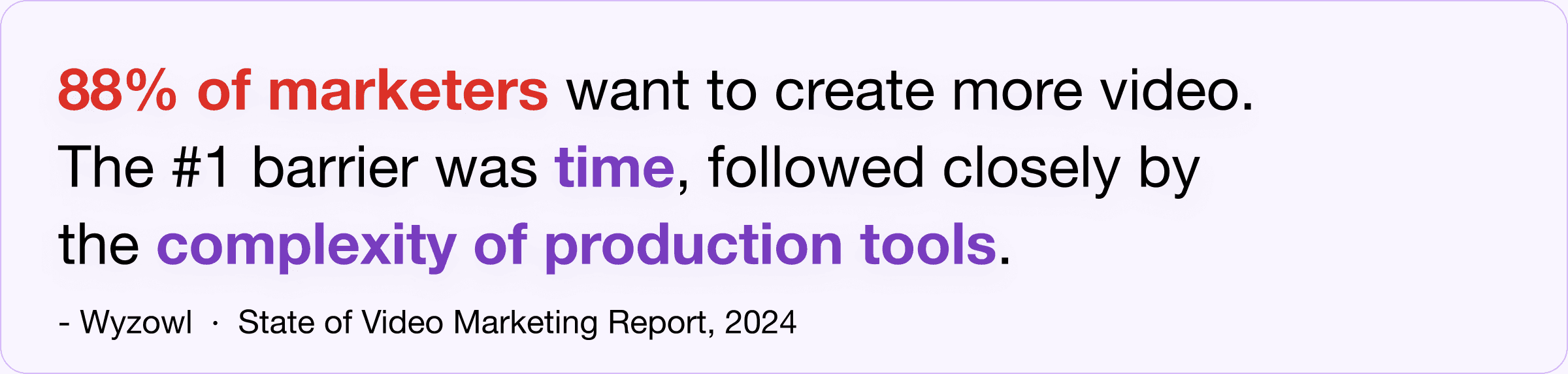
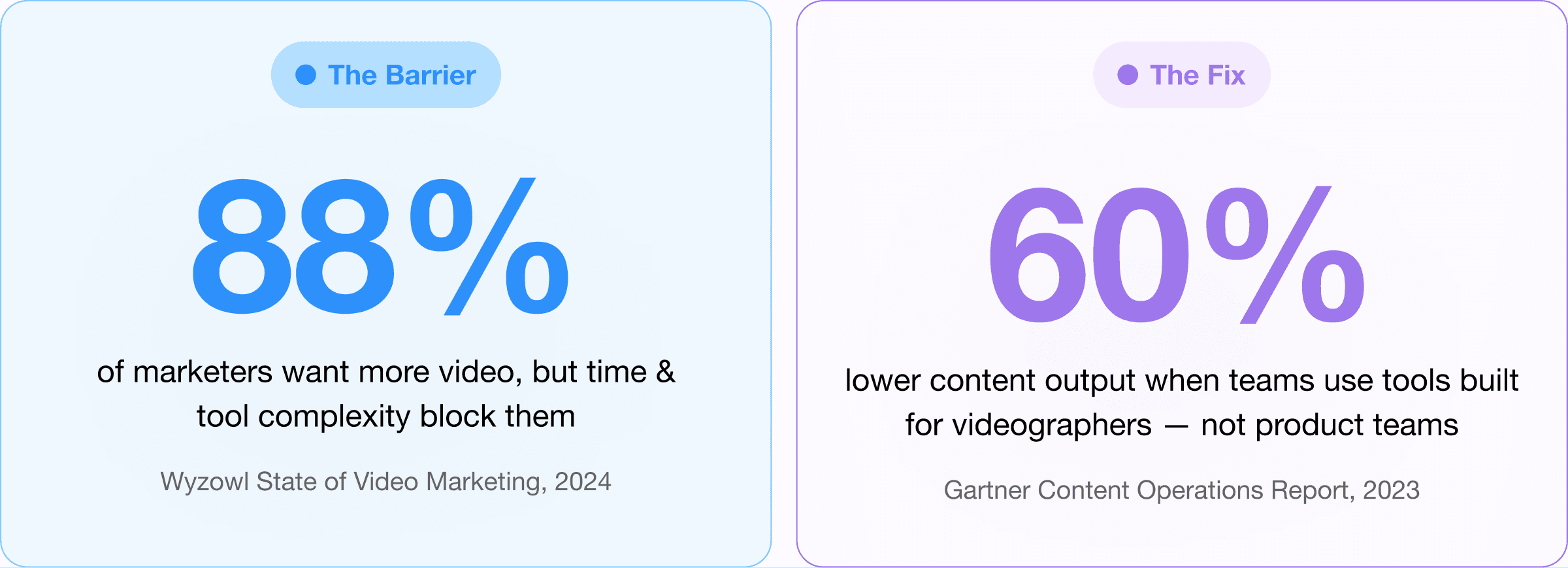
"In a 2024 survey by Wyzowl, 88% of marketers said they want to create more video content. The same survey found that the #1 barrier was time, followed closely by the complexity of production tools."
That is not a motivation problem. That is a tooling problem.
The Real Issue: Your Tools Were Built for a Different Job
The video production stack most teams inherit was not designed for product documentation, customer education, or internal knowledge transfer. It was designed for media professionals.
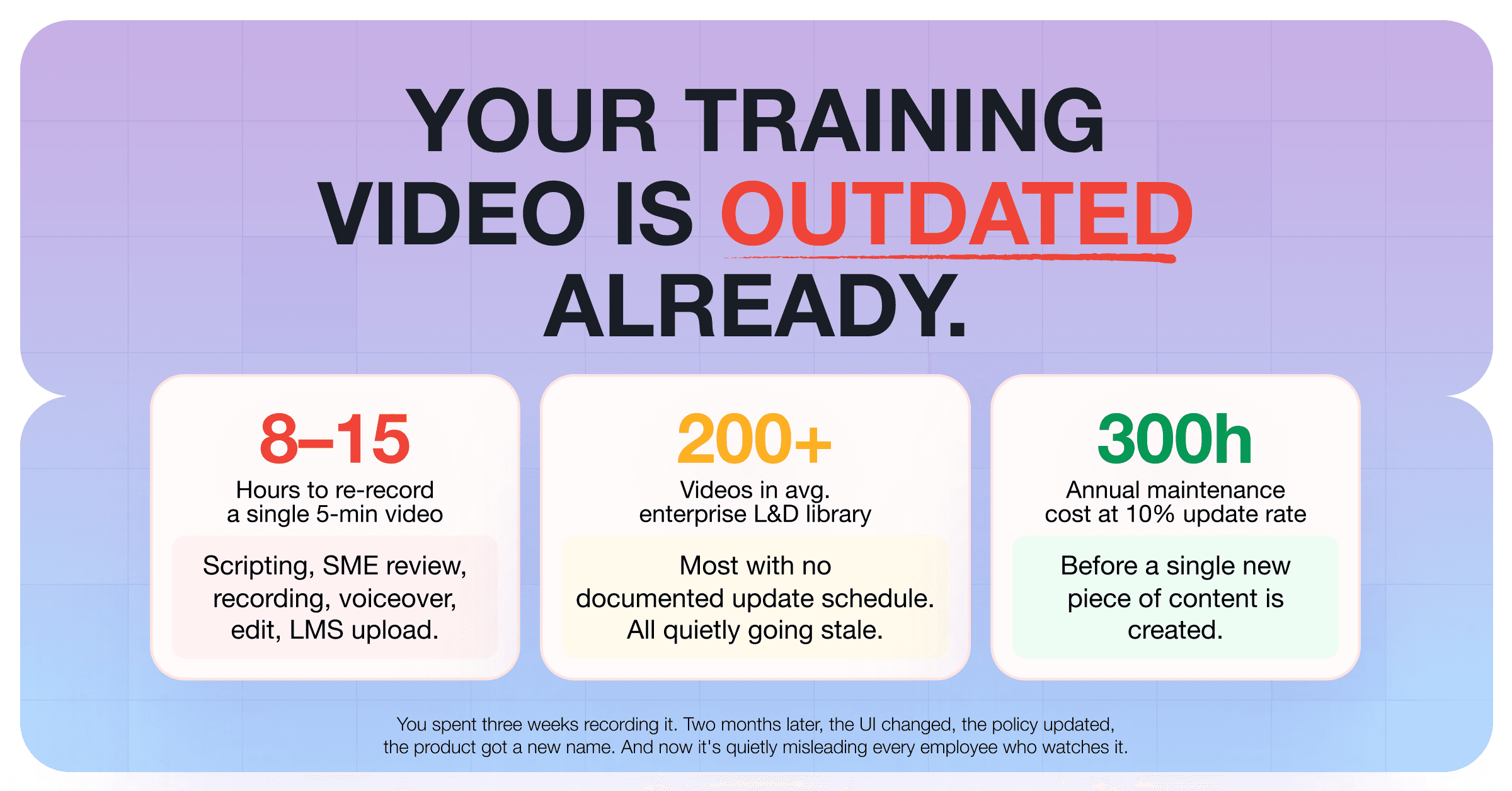
Premiere Pro. Final Cut. DaVinci Resolve. Even the more accessible tools like Camtasia or Loom still require meaningful judgment calls: which clips to cut, how to sync audio, when to trim silences, how to add and position captions, how to export for different platforms. Each decision takes time. Each skill has to be learned. Each step is a reason to procrastinate.
When you ask a product manager, a technical writer, or a customer success manager to create a video with these tools, you are not asking them to record content. You are asking them to become a video editor. That is a fundamentally different role, and most of them decline.
The friction is structural. And structural problems do not respond to motivation, encouragement, or setting a quarterly OKR around video output.
What High Friction Actually Costs
The cost of video friction rarely shows up on a spreadsheet, which is why it persists. But it surfaces reliably in other metrics:
Support volume stays high. Users who can't find clear video guidance contact your team instead. Zendesk's 2024 CX Trends Report found that 67% of support tickets could be avoided with better self-service content.
Feature adoption lags. Pendo's 2023 Product Experience Report found that 43% of users abandon a feature in the first week if they can't find clear guidance. Documentation that doesn't exist or exists only as dense text is functionally equivalent.
Onboarding stalls. Time-to-value extends when customers can't self-serve through setup. Every additional day to activation is a churn risk.
Your team creates less. When production is painful, teams create the minimum required. Coverage gaps widen. Documentation debt compounds.
These outcomes are not caused by a lack of ambition or investment in content. They are caused by a production process so friction-heavy that the realistic output is always too low.
The Insight: You Don't Need Better Videographers. You Need Better Tools.
This reframe matters more than it might appear.
If the problem is talent, the solution is hiring expensive, slow, and uncertain. If the problem is budget, the solution is making a business case for investment in people and equipment. Both solutions take quarters to implement and are hard to reverse if they don't work.
If the problem is friction specifically, tools designed for media professionals being used by product teams, the solution is changing the tools. That is a faster decision, a more measurable intervention, and a reversible one.
The right question to ask is not: "How do we get our team to create more video?" The right question is: "What would video creation look like if it took less time than writing a doc?"
Because when that threshold is crossed, when recording a polished walkthrough becomes genuinely faster than writing a 10-step text guide, the behaviour changes without any mandate. The incentive structure shifts on its own.
What This Looks Like in Practice
Organisations that have solved the friction problem share a few common characteristics:
They separate recording from production. Subject matter experts capture raw screen recordings or demos. A tool handles the rest - trimming, syncing, captioning, formatting for output.
They eliminate the editing bottleneck. No dedicated editor required. The output is customer-ready without specialist intervention.
They treat every demo as documentation. Product walkthroughs, sales demos, and CS calls become source material. Nothing is wasted.
They produce multilingual content by default. Captions and translations are generated automatically, not as a separate localisation project.
The result is not just more video content. It is a fundamentally different relationship between your team and content creation. One where video becomes the path of least resistance and not the ‘avoided alternative’.
What to Do With This
If you are a content leader looking at a team that says it cannot create video, the most useful thing you can do is not push harder. It is to audit the production process honestly.
Ask your team to time themselves creating a single video tutorial using their current tools, from raw recording to published output. Then ask them to time themselves writing an equivalent help article. If video takes more than twice as long, you have a tooling problem, not a capability problem.
The gap is closable. The friction is removable. And the upside higher feature adoption, lower support volume, better onboarding completion is measurable within a single quarter.
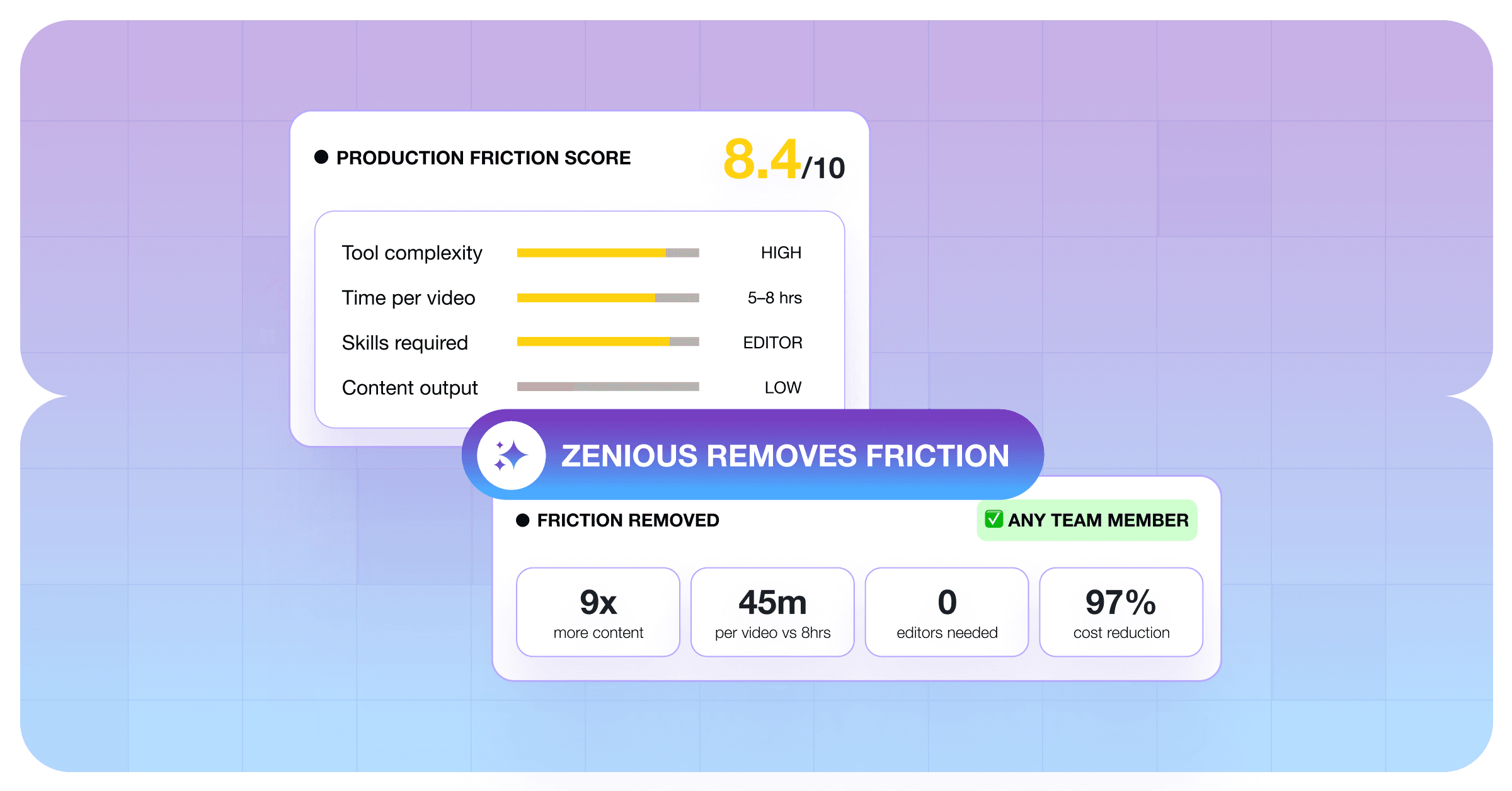
Zenious was built specifically to remove this friction. It takes raw screen recordings and messy demos and turns them into polished, customer-ready video documentation, without requiring anyone on your team to become a video editor. If your team has the content knowledge but not the production bandwidth, that is exactly the gap it closes.
Your customers already want video and your team already knows that. The only thing standing between where you are and a video-first documentation workflow is the production process.
And that is the one thing you can actually change.
Sources
Wyzowl. (2024). State of Video Marketing Report. wyzowl.com/video-marketing-statistics
Gartner. (2023). Content Operations and the Role of Tooling in Team Output.
Zendesk. (2024). Customer Experience Trends Report. zendesk.com/customer-experience-trends
Pendo. (2023). Product Experience Report: How Users Learn Software.
TechSmith. (2024). Video Viewer Habits Study. techsmith.com/blog/video-viewer-habits-study